
Category Archives: Culture & History

Guides to the cultural and historical places of Central Vietnam.

Tu Duc tomb

Born in 1829 and died in 1883, Tu Duc had reigned for over 35 years since 1848, longest among rulers of the Nguyen Dynasty. Tu Duc tomb, with some 50 constructions surrounded by a 1,500 m long wall, was built during 1864-1867.

Emperor Tu Duc was expert at philosophy, Oriental history and particularly literature (he left 4,000 verses and 600 proses) yet failed to successfully rule the country. He was crowned King in the historical period of Vietnam facing the Western developing capitalism. Having no son to succeed aggravated the situation and made him world-weary. To seclude himself, he ordered the construction of his tomb as a fairyland with poetical features, making it a lifetime recreation ground and a world for his eternal life after death.

With several palaces and specific man-made landscape, the with poetry and freedom. Perfect harmony is obtained of monuments and nature or nature improved on landscape gardening, a Vietnamese form of art. And, if un-symmetry is also a specific beauty of art, then Tu Duc Tomb enjoys it.

The architecture of Tu Duc Tomb reflects the poet-Emperor’s romantic nature, evokes pleasant surprise, creates much literary and art inspiration, makes strong impression on sightseers and arouses in them deep sympathy.
Thien mu pagoda – Pagoda Of The Heavenly Lady

The name, Thien Mu pagoda,takes its source from a legend. It was told that long ago, there appeared an old woman every night on the hill where the pagoda stands today. She told local people that a Lord would come and build a Buddhist pagoda for the country’s prosperity. Lord Nguyen Hoang, on hearing that, ordered the construction of a pagoda in 1601 and named it Pagoda of the Heavenly Lady.

Since then, it has been restored and developed several times. Two most important restorations took place during 1714 – 1715 in Lord Nguyen Phuc Chu’s reign and 1844 – 1846 under Emperor Thieu Tri. Thien Mu pagoda once had dozens of nice buildings.

In fact, the steps lead right from the water up to Thien Mu pagoda. Phuoc Duyen tower – an octagonal tower was built in 1844. There are smaller pavilions on 2 sides of the tower.

The Thien Mu pagoda area (280m x 100m) can be divided into two sectors separated by the Triple Gate. The front sector comprises memorials such as: the Phuoc Duyen Tower (seven – stored high : 21m), Big Bell (Weight: over two tons, cast 1710), Stele on Tortoise (carved 1715), Stele “Bell of Pagoda of the Heavenly Lady” (erected 1846)…The rear sector is a built – up area for the cult of Buddha and monks’ activities.

There preserved in the pagoda some precious antiquities, for example, the bronze gong cast in 1677, the 1714 wooden gilded board with Lord Nguyen Phuoc Chu’s inscription, etc.

Landscape and monuments, both in perfect harmony, keep mirroring themselves in the clear and quiet Perfume River. Only 4 km from Hue city center, Thien Mu pagoda evokes, however, in tourists the feeling of a peaceful and unearthly world.

Aside from the Hue citadel, Thien Mu Pagoda is another must see in Hue. If the weather is fine and take part in Hue city tour with us and get there.

Hue Noon Gate – Ngo Mon

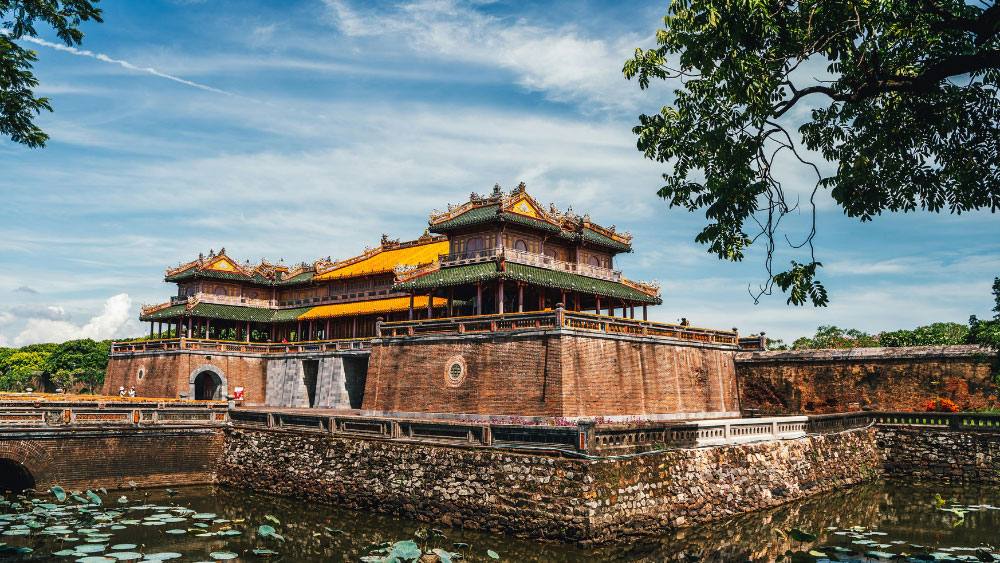
Noon Gate in Hue imperial city

Situated on the front of the Hue Imperial City, the Noon Gate was constructed in 1833 and reserved for the Emperor. It was also used as a tribune for Court regular and irregular festive occasions such as the Calendar Distribution Ceremony, Proclamation Ceremony of successful candidates in national examinations, Troops Parade, etc.

To fulfill these two functions, Noon Gate is divided into two parts, the foundation and the Five-Phoenix Pavilion. Both are U-shaped, symbolizing arms open for guests.

Hue Imperial City has five entrances. The middle is reserved for the Emperor, four side – entrances for other participants in the royal procession including elephants and horses.

The Five-Phoenix Pavilion has two stages. The top is formed by nine roofs. The middle roof, covered with yellow (colour used by the Emperor only) enameled tiles, shelters the monarch in ceremonious occasions. Eight side-roofs, covered with green enameled tiles, are seats for other members of the Court.

The pavilion is supported by 100 columns. According to Oriental concepts, 100 is an infinite and countless number.

Constructors of the Noon Gate appeared to be so good at designing, decorating and calculating the durability that, for almost 200 years, it has remained in good condition and is considered the most typical art symbol of the ancient Hue. the durability that, for almost 200 years, it has remained in good condition and is considered the most typical art symbol of the ancient Hue city.

Hue Imperial Citadel: A Historical and Cultural Landmark

Overview Hue Imperial Citadel

Hue Imperial Citadel has been recognized as one of the world’s cultural heritages by UNESCO. The Citadel is surrounded by two thick walls, Ngoai Thanh and Noi Thanh. Inside Ngoai Thanh is a small city that serves as the center of the Citadel, where the king and royal family lived. When visiting the Citadel at the right time, visitors will have the chance to admire the beautiful lotus flowers blooming on the surface of the lake outside Ngoai Thanh. Inside Ngoai Thanh is Noi Thanh. From the first steps to Noi Thanh in the direction of Ngo Mon gate, visitors will be awed by the great views that appear before their eyes.

Visitors’ first impression is probably the lake adjacent to the port, where carp swim and race to bite food. It’s amusing to watch the brightly colored flock of carp. Next, visitors can cross the first bridge across the lake to visit the most important architectural building, which is Thai Hoa Palace.

Other architectures inside the Citadel

This palace was only used for flanking, important banquets, and other ceremonies of the Royal family. Inside Thai Hoa Palace are magnificent gilded lacquer pillars. Around Thai Hoa Palace are other architectures:

  • Kien Trung Palace – where the mandarins prepared before flanking.
  • The Mieu – where the Nguyen Dynasty’s kings are worshipped.
  • Dien Tho Palace – the residence and daily living quarters of the King’s Mother.
  • Hien Lam Cac – the memorial to remember the merits of the Nguyen Dynasty’s kings and courtiers who had great success in the dynasty.
  • Nine Dynastic Urns – 9 copper urns that symbolize a prosperous, unified country and a dynasty that endures. Each urn has a particular name: Cao Dinh, Nhan Dinh, Chuong Dinh, Anh Dinh, Nghi Dinh, Thuan Dinh, Tuyen Dinh, Du Dinh, and Huyen Dinh.
  • Ta Vu and Huu Vu – the place where courtiers prepare rituals, the workplace of Co Mat Vien, and where competitions and banquets are organized.
  • Thai Binh Lau – where the king rests in his spare time, reads, writes, poetizes, and relaxes.
  • Duyet Thi Duong – the main stage where performers sing for the King, royal family, and courtiers in the dynasty.

Travel Guide for visiting Hue Imperial citadel

Hue Imperial Citadel is a must-visit destination for those interested in history, architecture, and culture. Here are some tips for visiting:

  • Wear comfortable shoes as there is a lot of walking involved.
  • Bring a hat, sunglasses, and sunscreen as it can get hot.
  • Consider hiring a local guide to learn more about the history and significance of the various buildings and structures.
  • Take your time and enjoy the beautiful scenery, including the lotus flowers on the lake.
  • Don’t miss the Thai Hoa Palace, which is the most important building in the Citadel.
  • Visit in the morning to avoid the crowds and the heat.