Dong Khanh tomb

Emperor Dong Khanh was born in 1864, crowned in 1886 and breathed his last only 3 years later in 1889 at the age of 25. He was also Emperor Tu Duc’s nephew and foster-son.

Since the reign of Dong Khanh, in other words, after the fall of the Hue city (5 July 1885), Vietnam completely surrendered her independence to France. In his daily life, the Emperor took to wine, perfume, using alarm – clock, hat, shoes… imported from the “mother country”.

King died young, having no time to start his tomb construction. Most of the monuments of the tomb were simply planned and built during the first year of Emperor Thanh Thai’s reign (1889), improved and completed in the years 1916, 1917, 1921 and 1923 under Emperor Khai Dinh (Dong Khanh’s king son).

The tomb was localted in Cu Si Hamlet, now Thuong Hai Village, Thuy Xuan, Hue City. It’s only 8km from the city center.

The tomb has 20 monuments, both principal and secondary. Like those proceeding Emperors (Thieu Tri, Tu Duc and Duc Duc), Dong Khanh tomb is divided into two areas, the tomb and the temple, 100 m apart.

The Ngung Hy Temple, dedicated to the cult of the king and his two Queen, is the monument of greatest value of art. Most noteworthy are the building materials and decoration. Aside from the elaborate exterior decoration, the interior is lacquered red, gilded and richly adorned.

As a whole, the king tomb is pretty, delicate and bears to some extent the cross – cultural stamp of European and Asian civilizations in late nineteenth early twenty centuries.

Now, if you want to visit Dong Khanh mausoleum, you can join Hue city tour with Hue Easy Rider team, it is closed with Tu Duc tomb by 5 mins walking.

Duc Duc Tomb

Besides simplicity in architecture, Duc Duc Tomb also has the following characteristics. It is:

–         The tomb of an Emperor who reigned for only 3 days before his being dethroned and jailed to death by the Court.

–         The nearest tomb to the Hue citadel (8 Duy Tan St.).

–         The tomb compound containing two others of Emperor Thanh Thai and Duy Tan.

–         The tomb constructed several times after the Emperor’s death as a result of the Nguyen Dynasty decadence.

Born in 1852 and died in 1883, Duc Duc was Emperor Tu Duc nephew and eldest foster – son. Because of Duc Duc’s pro – French attitude, he was dethroned by the Court just after his three – day succession to the throne in June 1883.

In 1889, the irony of history found Duc Duc’s son crowned as Emperor Thanh Thai. He then built his father’s tomb and a nearby temple in 1899. Due to his anti – French thoughts, Thanh Thai was later replaced by his son, Duy Tan, in 1907. In 1916, Duy Tan’s attempted overthrow of the French rulers was discovered. Both father and son were exiled to the Reunion Island (Africa).

Relics of Thanh Thai and Duy Tan were brought back to Hue city and buried in the tomb in 1954 and 1987, respectively. The three Emperors have been honoured in the temple.

Though simple in architecture and decoration, Duc Duc Tomb has in common the architectural manner with others and artistic style of it’s own. It marks an eventful historical period of the Nguyen Dynasty and enriches the Royal tomb compound in Hue city.

Minh Mang tomb

Minh Mang tomb Zenith of the Nguyen Dynasty was reached during the reign of Emperor Minh Mang (1820-1840). Minh Mang tomb was built 12km from Hue city in four years (1840-1843) by some 10,000 soldiers and workers.

The tomb consists of about 40 monuments of various dimensions. All lie within a wall, oval in shape and 2,000 m in circumference.

Running east-west from the Dai Hong Gate to the farthest part of the surrounding wall, the main axis of the tomb is 700 m long. Along it, most important constructions such as the Salutation Court, Stele House, Sung An Temple, Minh Lau Pavilion and the tomb are built. On both sides, secondary monuments are symmetrically arranged in pairs.

Main entrances to the monument complex open to varied scenes, offering visitors pleasant sights.

Minh Mang tomb is a simple architectural complex consisted of 40 constructions designed on a symmetric axis from main gate to Surrounding Wall behind the mausoleum.

Most of the monuments mirror themselves in man-made lakes.

The construction is built into 3 mains parallel axis with Than Dao path is the centre.

Dai Hong gate – the main gate. The gate presents three paths with 24 heaving roofs. The gate was opened only once to bring the king’s coffin to mausoleum and was closed since then. Now we go inside by side-gates are Huu Hong Mon (Right Gate) and Ta Hong Mon (Left Gate)

On Than Dao path, behind Dai Hong Gate is the Honour Courtyard with its two rows of elephants, horses’ statues and mandarins. Stele Pavilion is on Phung Than Mount inscribed with Minh Mang’s biography and  his merits written by Thieu Tri.

The tomb planning reflects the strict social organization in Minh Mang times, the centralism and the monarch’s Confucian inclination.

Besides solemnity and symmetry, the tomb is also a tourist attraction with the natural surroundings smartly improved as a background for it’s monuments.

Book tour Hoi An to Hue and explore royal tomb in Hue now.

Khai Dinh tomb

Emperor Khai Dinh (1885 – 1925) ruled the country for 9 years from 1916 to 1925. His tomb, however, was built within 11 years, from 1920 to 1931, much longer than his reign.

Under Khai Dinh, Western culture vigorously infiltrated into Vietnam. Khai Dinh himself made a tour to France in 1922. As a result, in his tomb, several elements of the western architecture have been intermingled with the nation’s traditional art, particularly the use of concrete in place of wood, ardoise slates for roofing, iron gates, lightning rods, electric lamps, etc.

Mountains, hills and rivulets round the tomb are exploited to fulfill the feng-shui requirements thus offer the tomb a majestic environment.

Unique value of art of the tomb lies with the decoration skill obviously seen in the Thien Dinh Residence. It’s interior decoration features colourful mosaics made of millions of ceramic chips.

With diligence and expert hands, artisans of Khai Dinh times have created hundreds of mosaic bas – relief, all elaborate and attractive with graphic designs and arabesques despite the hardness of the materials.

The residence interior resembles a museum of fine arts with pleasing design in bas – relief which express joy, decorative characters “Tho” (Longevity) and “Phuc” (Happiness), life-size sculpture of the Emperor, showcases for Royal robes, etc.

Khai Dinh Tomb has been classified as a work of “neo – classicium” in Vietnam’s history of fine arts and really a place where “mourning smiles”.

Join Hue city tour 1 day and explore this tomb

Hue Royal tomb, A Wonder

Hue Royal tomb, A Wonder

Hue city has seven tombs of seven Emperors of the Nguyen Dynasty, planned and constructed in the hilly region southwest of the Citadel, Hue Royal tomb – namely: Gia Long, Minh Mang, Thieu Tri, Tu Duc, Duc Duc, Dong Khanh and Khai Dinh. They have in common the following features:

–         The construction was started almost during the Emperor’s reign.

–         Each tomb has dozens of splendid monuments in perfect harmony with poetical natural environment.

–         Constructions in each tomb are often arranged in the following order: wall, triple gate, Salutation Court, Stele House, temples, lakes and ponds, pavilions, garden, and finally, the tomb itself.

According to Oriental outlook, life is ephemeral and death means returning to the peaceful and eternal world.

Hue Royal tomb is, therefore, the living world of the deceased and splendid achievements of Vietnamese traditional architecture.

The Hue Royal tomb was also included in the List of World’s Wonders in “Les Merveilles du Monde” published in 1957 in France.

Apart from the above similarities, each tomb also has it’s own artistic features in accordance with an Emperor’s character -Hue Royal tomb:

–         Gia Long Tomb: Strenght and serenity.

–         Minh Mang Tomb: Solemnity.

–         Thieu Tri Tomb: Freedom.

–         Tu Duc Tomb: Lyricism.

–         Duc Duc Tomb: Simplicity.

–         Dong Khanh Tomb: Delicacy.

–         Khai Dinh Tomb: Sophistication.

Tu Duc tomb

Born in 1829 and died in 1883, Tu Duc had reigned for over 35 years since 1848, longest among rulers of the Nguyen Dynasty. Tu Duc tomb, with some 50 constructions surrounded by a 1,500 m long wall, was built during 1864-1867.

Emperor Tu Duc was expert at philosophy, Oriental history and particularly literature (he left 4,000 verses and 600 proses) yet failed to successfully rule the country. He was crowned King in the historical period of Vietnam facing the Western developing capitalism. Having no son to succeed aggravated the situation and made him world-weary. To seclude himself, he ordered the construction of his tomb as a fairyland with poetical features, making it a lifetime recreation ground and a world for his eternal life after death.

With several palaces and specific man-made landscape, the with poetry and freedom. Perfect harmony is obtained of monuments and nature or nature improved on landscape gardening, a Vietnamese form of art. And, if un-symmetry is also a specific beauty of art, then Tu Duc Tomb enjoys it.

The architecture of Tu Duc Tomb reflects the poet-Emperor’s romantic nature, evokes pleasant surprise, creates much literary and art inspiration, makes strong impression on sightseers and arouses in them deep sympathy.

Thien mu pagoda – Pagoda Of The Heavenly Lady

The name, Thien Mu pagoda,takes its source from a legend. It was told that long ago, there appeared an old woman every night on the hill where the pagoda stands today. She told local people that a Lord would come and build a Buddhist pagoda for the country’s prosperity. Lord Nguyen Hoang, on hearing that, ordered the construction of a pagoda in 1601 and named it Pagoda of the Heavenly Lady.

Since then, it has been restored and developed several times. Two most important restorations took place during 1714 – 1715 in Lord Nguyen Phuc Chu’s reign and 1844 – 1846 under Emperor Thieu TriThien Mu pagoda once had dozens of nice buildings.

In fact, the steps lead right from the water up to Thien Mu pagoda. Phuoc Duyen tower – an octagonal tower was built in 1844. There are smaller pavilions on 2 sides of the tower.

The Thien Mu pagoda area (280m x 100m) can be divided into two sectors separated by the Triple Gate. The front sector comprises memorials such as: the Phuoc Duyen Tower (seven – stored high : 21m), Big Bell (Weight: over two tons, cast 1710), Stele on Tortoise (carved 1715), Stele “Bell of Pagoda of the Heavenly Lady” (erected 1846)…The rear sector is a built – up area for the cult of Buddha and monks’ activities.

There preserved in the pagoda some precious antiquities, for example, the bronze gong cast in 1677, the 1714 wooden gilded board with Lord Nguyen Phuoc Chu’s inscription, etc.

Landscape and monuments, both in perfect harmony, keep mirroring themselves in the clear and quiet Perfume River. Only 4 km from Hue city center, Thien Mu pagoda evokes, however, in tourists the feeling of a peaceful and unearthly world.

Aside from the Hue citadel, Thien Mu Pagoda is another must see in Hue. If the weather is fine and take part in Hue city tour with us and get there.

Hue Noon Gate – Ngo Mon

Noon Gate in Hue imperial city

Situated on the front of the Hue Imperial City, the Noon Gate was constructed in 1833 and reserved for the Emperor. It was also used as a tribune for Court regular and irregular festive occasions such as the Calendar Distribution Ceremony, Proclamation Ceremony of successful candidates in national examinations, Troops Parade, etc.

To fulfill these two functions, Noon Gate is divided into two parts, the foundation and the Five-Phoenix Pavilion. Both are U-shaped, symbolizing arms open for guests.

Hue Imperial City has five entrances. The middle is reserved for the Emperor, four side – entrances for other participants in the royal procession including elephants and horses.

The Five-Phoenix Pavilion has two stages. The top is formed by nine roofs. The middle roof, covered with yellow (colour used by the Emperor only) enameled tiles, shelters the monarch in ceremonious occasions. Eight side-roofs, covered with green enameled tiles, are seats for other members of the Court.

The pavilion is supported by 100 columns. According to Oriental concepts, 100 is an infinite and countless number.

Constructors of the Noon Gate appeared to be so good at designing, decorating and calculating the durability that, for almost 200 years, it has remained in good condition and is considered the most typical art symbol of the ancient Hue. the durability that, for almost 200 years, it has remained in good condition and is considered the most typical art symbol of the ancient Hue city.

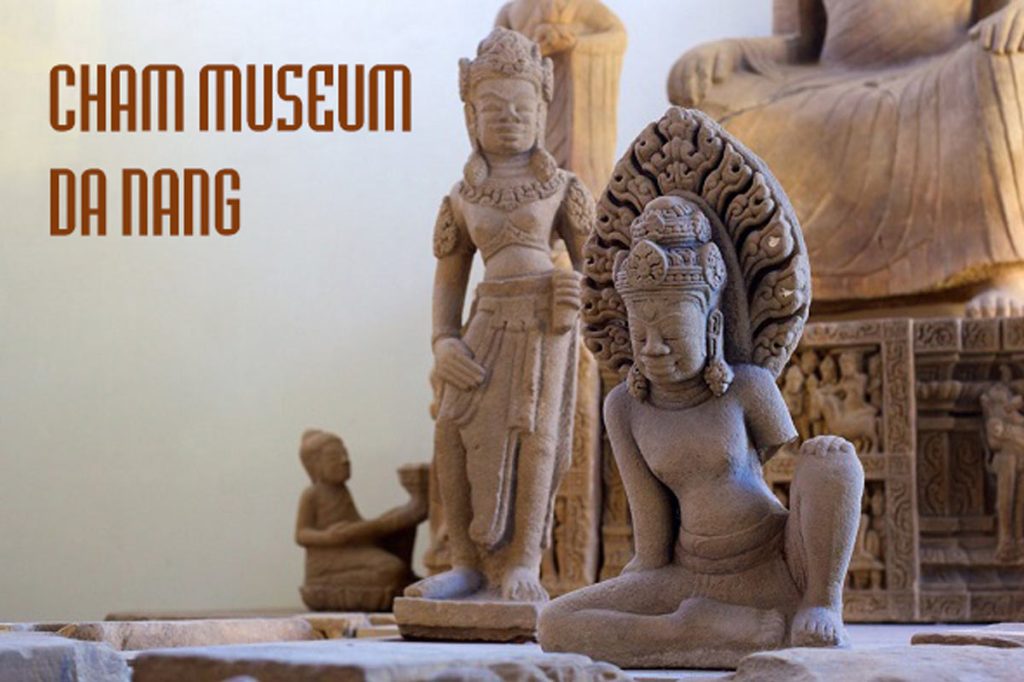
Cham Sculpture Museum

Overview of Cham Museum

The Cham Sculpture Museum is an essential destination for anyone interested in discovering the Cham culture and history of Vietnam. It is located in the city of Da Nang and boasts the world’s largest collection of Cham sculptures, which date back to the 7th to 15th centuries and are made from sandstone, terracotta, and bronze. The museum houses over 300 artifacts that were collected from various archaeological sites in Central Vietnam.

The Cham civilization was once a dominating kingdom in Central and Southern Vietnam, and their culture has had a profound influence on the region. The Cham people excelled in art, sculpture, literature, and architecture, and the museum offers a glimpse into their rich history and traditions. The collection includes various sculptures of gods, goddesses, animals, and humans that were once used in religious rituals and ceremonies.

History

The museum was established in 1915 by the French colonial government to preserve the Cham artifacts that were being looted and sold on the black market. Today, the Vietnamese government manages the museum, which has become a popular tourist attraction. The museum has undergone several renovations and expansions over the years and now has modern facilities with interactive exhibits that educate you about the Cham people and their culture.

You can explore the various galleries that showcase the Cham sculptures and artifacts. The galleries are divided into different periods in Cham history, and each gallery has a detailed description of the artifacts on display. The museum also has an outdoor area where you can see larger sculptures and enjoy a view of the nearby Han River.

Guided Tours and Cultural Events

For those interested in learning more about the Cham culture, the museum offers guided tours and audio guides in multiple languages. The guided tours provide detailed information about the Cham civilization and their cultural practices, while the audio guides offer a more flexible and self-paced experience. The museum also hosts cultural events and performances throughout the year, which include traditional music, dance, and martial arts.

If you’re planning a trip to Da Nang, make sure to visit the Cham Sculpture Museum. The museum is open daily from 7:00 am to 5:00 pm, and admission is affordable. You can easily access the museum by public transportation or taxi, and it is approximately a 10-minute drive from the city center and a 20-minute drive from Da Nang International Airport.

Travel Guide

Getting there

The Cham Sculpture Museum is located in the heart of Da Nang city, making it easily accessible by public transportation or taxi. The museum is located at 02, 2 Tháng 9, Bình Hiên, Hải Châu, Đà Nẵng. It is approximately a 10-minute drive from the city center and a 20-minute drive from Da Nang International Airport. You can take a public bus or a taxi to reach the museum. There are also several tour companies that offer guided tours to the museum as part of their itinerary.

Admission fees

The admission fee for the Cham Sculpture Museum is 60,000 VND for adults and 40,000 VND for children. Guided tours and audio guides are available for an additional fee. The guided tours cost around 150,000 VND per person, and the audio guides are available for 50,000 VND. The museum also offers discounted rates for groups of 10 or more people.

Hours of operation

The museum is open daily from 7:00 am to 5:00 pm. The last admission is at 4:30 pm, and you are advised to arrive at the museum before 4:00 pm to have enough time to explore the galleries.

What to bring

You should wear comfortable clothing and shoes as there is a lot of walking involved. The museum has several floors, and you need to climb stairs to reach the galleries. It is also recommended to bring sunscreen and a hat as the outdoor area can get quite hot during the day. You should also bring a camera to capture the beautiful sculptures and artifacts.

Nearby attractions

The Cham Sculpture Museum is located near several other popular tourist attractions in Da Nang, including the Marble Mountains, Han River, and Dragon Bridge. You can easily spend a full day exploring the area. The Marble Mountains are a series of five hills made of limestone and marble, which offer a panoramic view of the surrounding area. The Han River is a scenic river that flows through the city and offers a variety of activities such as boat rides and water sports. The Dragon Bridge is a unique attraction that features a dragon-shaped bridge, which spits fire and water every Saturday and Sunday night. You can also explore the nearby markets and restaurants to experience the local cuisine and culture.

In conclusion, the Cham Sculpture Museum is an excellent destination for anyone interested in history, art, and culture. The museum offers a unique and fascinating insight into the Cham civilization, which has left a significant impact on Vietnamese culture. You can spend hours exploring the galleries and learning about the Cham people and their traditions. The museum’s location in Da Nang also makes it an ideal base for exploring the surrounding area and experiencing the local culture.

Elephant Spring in Hue

Elephant Springs is a series of natural springs and waterfalls located in the picturesque countryside outside of Hue, Vietnam. The area is surrounded by lush green forests and the water is crystal clear. Visitors can take a dip in the cool water or trek through the nearby jungle to explore the natural surroundings. The name “Elephant Springs” comes from the shape of one of the larger pools, which is said to resemble an elephant. The area is a popular spot for tourists and locals alike, who come to relax and enjoy the beauty of nature. Elephant Springs is a must-visit destination for nature lovers and adventure seekers. The waterfalls and pools offer a refreshing respite from the hot and humid weather of Hue. Visitors can swim, bathe, or simply sit and enjoy the view of the serene surroundings.

The area is also a great spot for trekking and hiking, with several trails leading through the lush forests and over the rocky terrain. Along the way, visitors can spot various species of birds, butterflies, and other wildlife.

For those who prefer a more leisurely pace, there are several picnic areas and restaurants in the vicinity, where visitors can enjoy a meal or a drink while taking in the beauty of the landscape.

Elephant Springs is a great place to spend a day or two, exploring the natural wonders of Vietnam and enjoying some much-needed relaxation.

How to get there?

There are a few options for getting to Elephant Springs. One is to take a motorbike tour from Hue to Hoi An, which usually includes a stop at the springs. Another option is to hire a private car to take you there.I apologize, allow me to provide more information on how to get to Elephant Springs.

From Hue, you can take a taxi, motorbike, or private car to get to Elephant Springs. The travel time is approximately 45 minutes to an hour. If you prefer to take a motorbike, you can rent one in Hue or book a motorbike tour that includes a stop at the springs. For a more comfortable and hassle-free experience, you can also hire a private car or book a tour that includes transportation.