Introduction to the Nguyen Dynasty’s Cultural Legacy
The Nguyen Dynasty (1802-1945), the last monarchical dynasty in Vietnam’s history, left a remarkable cultural legacy: a group of Royal tombs between Mount Ngu and the Huong River (Perfume River).
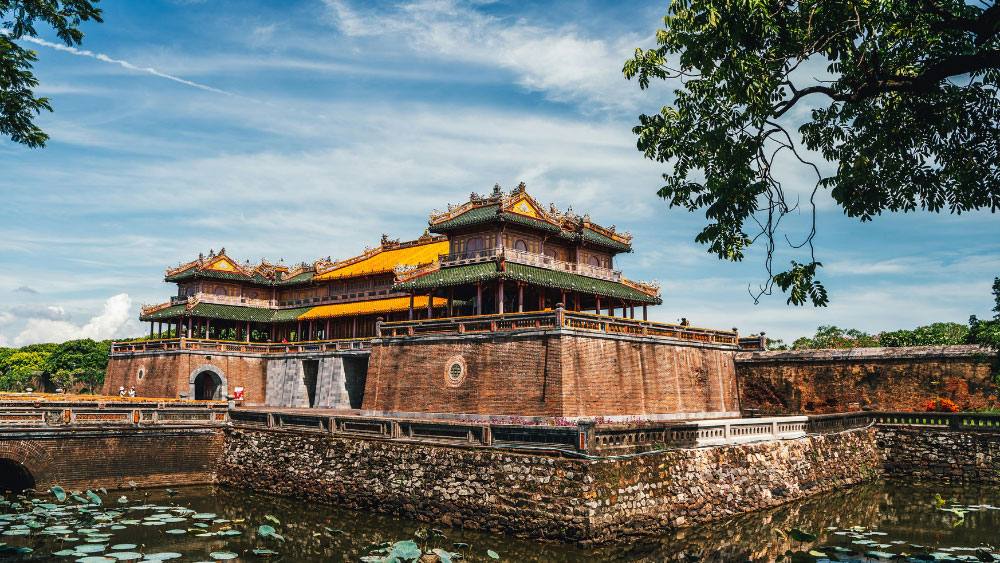
In the early 1910s, Eberhard wrote: “Hue is an attractive tourist center famous for the Citadel, the Royal City, and the Royal tombs which have attracted the special attention of visitors and artists. The Royal tombs of the Nguyễn Kings alone are valuable enough for tourism and are more beautiful than those of the Ming Kings in China.” Many Vietnamese and foreign specialists in culture and art have claimed that the Royal tombs in Hue are among the most brilliant achievements of ancient Vietnamese architecture.
Overview of the Seven Tombs and Their Locations
There were thirteen Kings of the Nguyễn Dynasty, but only seven built tombs that can be viewed today. The reasons for this involve complicated historical factors, which require careful historical study. The seven tombs that can be seen in Hue today belong to the Kings Gia Long, Minh Mang, Thieu Tri, Tu Duc, Duc Duc, Dong Khanh, and Khai Dinh. According to the original design of the Nguyễn Capital, drawn up in the early 19th century, the location reserved for the tombs is in a secluded area to the west of the Hue Citadel, as observed from the center of the Hue Ancient Capital. Many inscriptions found in this area indicate that the King was associated with the Sun and considered the incarnation of the Supreme Deity. The setting of the sun indicated the decease of a King, and it was believed that after death, the King traveled westward with the sun to rest in the tranquility of the mountainous area where the serene and poetic Huong River flows.
Philosophical and architech Behind the Tombs’ Design
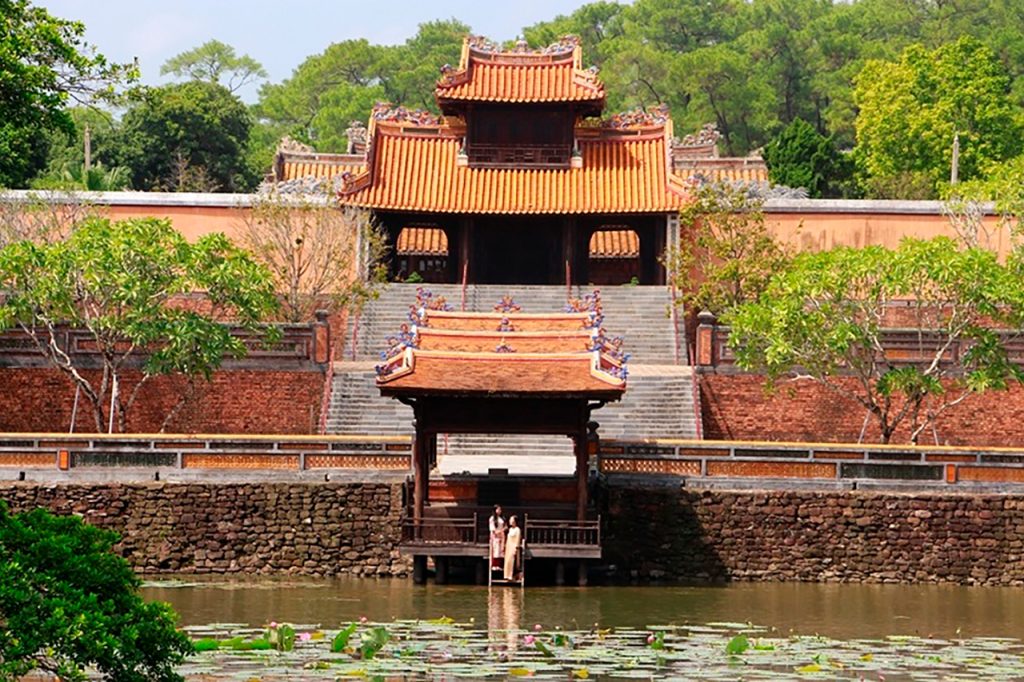
According to another way of thinking, death is life, and therefore, the Royal tombs in Hue are not sorrowful places. Each of them is divided into two main sections: one for graves and the other for temples, palaces, and pavilions, frequented by the Kings for enjoyment. The latter section can be seen as the second royal palace of the contemporary King. In Tu Duc Tomb, for instance, there are many architectural structures of different sizes built for the King’s daily activities and entertainment.
They include Hoà Khiem Palace as the King’s workplace, Luong Khiêm Palace as the King’s sleeping and dining place, and Xung Khiêm Pavilion and Dû Khiêm Pavilion where the King sat to fish, write poems, and enjoy a view. Luru Khiêm Lake was where the King rowed about to pick water lilies. Minh Khiêm Hall was a center, and Y Khiêm Palace and Tri Khiêm Palace were where the King’s concubines and maids stayed when they followed the King here.
The Role of the Tombs in Vietnamese Culture and History
After a King died, all the architectural structures in his tomb were kept intact and dedicated to his worship. His concubines and maids had to stay there to take care of his grave until they themselves died. They had to consider ‘death as life, inexistence as existence’ with all the meanings of this dogma, as well as with loyalty to the deceased King. After a King died, his tomb became his new living place.
The division of each Royal tomb in Hue into two sections and its architectural style is determined by the concept of “eternal life after death.” Accordingly, life on Earth is temporary. Even though one may live up to one hundred years, life is just a dream. Everything is impermanent and changeable like clouds. Thus, each Royal tomb in Hue is a palace in the other world, to which they return for eternal life.
UNESCO Recognition and Global Significance
Because of this perception of life and death, each of the Nguyễn Kings, except one, had his tomb built while still alive and on the throne. Recently, a critic from the UNESCO Committee of the Center for Asian Culture made a brief but profound assessment of the underlying philosophy of the tomb architecture of the Nguyễn Kings: “With the short-lived paradise on earth, the impressive tombs were built for an eternal paradise later.”
The architecture of the Royal tombs in Hue has its language with profound meanings. Only by understanding it can one explain why each of these Royal tombs has a system of palaces for entertainment and theatres for the enjoyment of theatrical arts and beautiful women, why the interior of Thien Dinh Palace in Khai Dinh tomb looks like an attractive and sparkling art museum, and why these Royal tombs are decorated with so many patterns in the shapes of the Chinese characters for “longevity” and “happiness.”
The architecture of the Royal tombs in Hue also reflects a peaceful and wise attitude toward the inevitability of death. In some of them, the tomb and temple sections are separated only by a tiny distance. When coming to the palaces for entertainment, the Kings would have a quick look at their graves, which had been dug in advance, without feeling worried or frightened. Having understood thoroughly the natural law of human lif
e, they would feel happy before death and be ready for it to come, leading them to the other world. There they would find their eternal houses, their final resting places, and their everlasting worlds. The Royal tombs in Hue show a synthesis of the sacred and profane and represent the world of the dead. Thanks to their artistic architecture, the often-felt mournfulness was greatly replaced with joy.
In summary, thanks to the ideological theme springing from the outlook on life as a synthesis of Eastern philosophies, as well as the marvelous artistic talent of the Vietnamese architects of the time, the Royal tombs in Hue have become colorful and fragrant flowers of art blossoming in the mountainous area of Hue. These Royal tombs have unique features that differentiate them from other tomb structures worldwide. Each Royal tomb in Hue is a historical and cultural site and a beauty spot with charming parks. Moved by the beauty of the Royal tombs in Hue, both natural and supernatural, each part in this poem refers to a Royal tomb in the area of Ngu Mountain and the Huong River.
They are built on the same principles but have different styles of art, succinctly described by the adjectives below:

Gia Long Tomb: imposing, grand, magnificent

Minh Mang Tomb: solemn, serious
Thieu Tri Tomb: light, buoyant, supple, flexible

Tu Duc Tomb: poetic, lyrical, graceful, refined
Duc Duc Tomb: simple and modest

Dong Khanh Tomb: pretty, charming

Khai Dinh tomb: sophisticated, polished, and refined
As a final tribute, in 1957, because of their high cultural and artistic value, the Royal tombs in Hue were classified as one of the world’s wonders by a group of fifteen Western scholars, as recorded in the book Les Merveilles du Monde (Wonders of the World) by Jean Cocteau of the French Academy.
Discover the beauty and cultural significance of the Royal tombs in Hue, Vietnam. Learn about the unique architectural styles of each tomb and the Nguyen Dynasty’s philosophical approach to death and the afterlife. Explore why these tombs have been classified as one of the world’s wonders and continue to attract visitors from around the globe.
Explore the Royal tombs of Hue, Vietnam, and discover their beauty and cultural significance. Each tomb has a unique architectural style and is tied to the Nguyen Dynasty’s philosophical approach to death and the afterlife. These tombs are considered one of the world’s wonders and continue to attract visitors from around the globe.